

Many people try to work out their blood alcohol concentration, or BAC, after drinking to decide whether they are safe to drive or continue their day as normal. This often happens after a night out, at a social event, or the morning after drinking. While estimating BAC without proper testing may seem convenient, it is far less reliable than many people realise, which is why many individuals choose to use accurate personal breathalysers instead of relying on guesswork.
Alcohol affects everyone differently. Factors such as body composition, drinking speed, food intake, and metabolism all influence how alcohol is processed. This means that estimating BAC without objective measurement can lead to inaccurate assumptions and risky decisions.
This guide explains how people commonly try to estimate BAC, why these methods are often inaccurate, and what to consider when making decisions around alcohol and driving.
Key Takeaways
- Estimating BAC using drink counting, calculators or time rules is unreliable because alcohol affects everyone differently.
- You can feel sober while still being over the legal or safe limit due to tolerance and delayed alcohol absorption.
- Relying on BAC estimates increases the risk of unsafe driving and serious legal consequences.
- A personal breathalyser provides real time objective information that supports safer and more informed decisions.
What Is Blood Alcohol Concentration (BAC)?
Blood alcohol concentration refers to the amount of alcohol present in your bloodstream, expressed as a percentage. Even small increases in BAC can affect reaction time, judgement, coordination, and concentration.
When you drink alcohol, it is absorbed into your bloodstream through your stomach and small intestine. From there, it travels throughout the body and is eventually broken down by the liver. Some of the alcohol in your blood passes into your breath through the lungs, which is why breathalysers can estimate BAC by analysing breath samples.
BAC does not rise or fall in a perfectly predictable way. It changes based on how quickly alcohol is absorbed and how efficiently your body processes it, which varies significantly from person to person.
Common Ways People Try to Estimate BAC
Many people rely on rough calculations or assumptions to estimate their BAC. While these methods may provide a general idea, they are not precise and can be misleading.
Counting Standard Drinks
One of the most common methods is counting standard drinks. This approach assumes that each drink contributes a predictable amount of alcohol to the bloodstream.
In reality, drink sizes and alcohol strength vary widely. Cocktails, mixed drinks, and home pours often contain more alcohol than expected. Even beer and wine can vary significantly depending on brand and serving size. These variations make drink counting an unreliable method for estimating BAC.
Using Online BAC Calculators
Online BAC calculators attempt to estimate BAC based on factors such as weight, sex, number of drinks, and time spent drinking. While these tools can provide a rough estimate, they rely on averages and assumptions that do not account for individual differences.
Most calculators cannot factor in how quickly drinks were consumed, how much food was eaten, hydration levels, or personal metabolism. As a result, two people entering the same information may receive estimates that do not reflect their actual BAC.
Time-Based Assumptions
Some people assume that their body processes alcohol at a fixed rate, often described as one standard drink per hour. This is a common myth that oversimplifies alcohol metabolism.
In reality, the rate at which alcohol is processed varies between individuals and situations. Drinking faster than your body can process alcohol causes BAC to rise, and alcohol can continue to be absorbed even after drinking stops.
Why Estimating BAC Is Often Inaccurate
Estimating BAC without testing is unreliable because alcohol affects people differently. There is no universal formula that accurately predicts BAC for everyone.
Factors such as body weight, sex, muscle mass, and liver function all influence alcohol metabolism. Food intake can slow alcohol absorption, while drinking on an empty stomach can cause BAC to rise more quickly. Hydration, fatigue, and medication can also affect how alcohol impacts the body.
Another important factor is delayed absorption. BAC can continue to rise after a person has stopped drinking, particularly if alcohol was consumed quickly. This means someone may feel fine initially but reach higher BAC levels later.
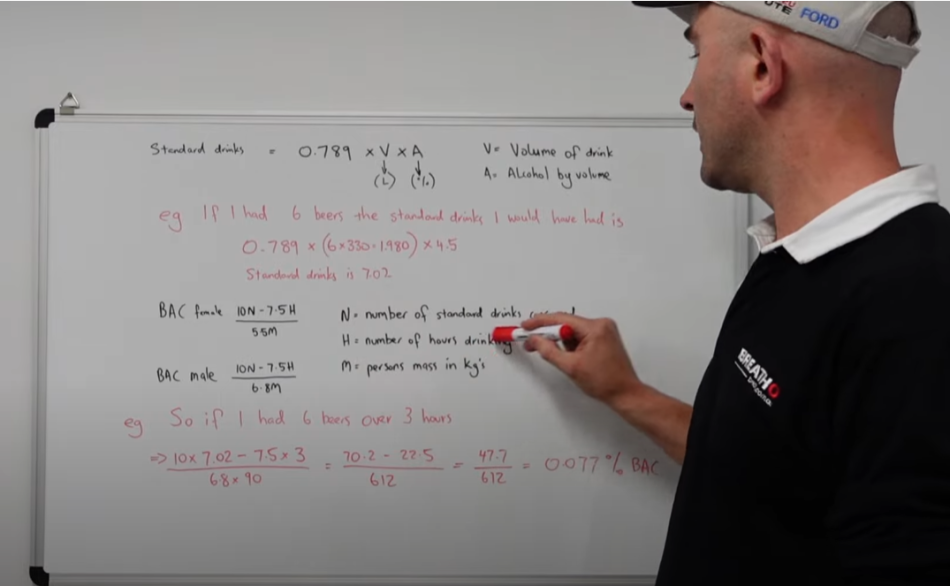
Here is the full formula below
The first thing you need to work out is standard drinks consumed. See formula below,
Standard drinks
0.789 x V x A
V= Volume of drinks in Litres
A= % of alcohol
Once you have your standard drinks consumed, you can now work out the estimated BAC with the below formula.
BAC for female 10N-7.5H/5.5M
BAC for males 10N-7.5H/6.8M
Let break this down…
N= number of drinks consumed
H= Number of hours drinking
M= Persons mass in KG
Lets do an example
Say if a male had 6 beers that were 330mls at 4.5% alcohol, my standard drinks are 0.789 x (6×330=1.98Litres) x 4.5= 7.02
Then we can workout the estimated BAC
10 x 7.2(standard drinks) – 7.5 x 3(hours drinking) divided by 6.8 x M(mass in KG’s) = 0.077% BrAC
Note… It’s important to note that these are estimated results. Do not rely on the results to measure your ability to drive after drinking alcohol.
Why You Can Feel Sober but Still Be Over the Limit
Feeling sober does not always reflect actual impairment. Many people develop tolerance to alcohol over time, meaning they may not feel as affected even when their BAC is elevated.
Tolerance can create a false sense of confidence. While a person may feel alert and capable, reaction time and decision-making can still be impaired. This disconnect between perception and reality increases the risk of unsafe decisions.
The morning after drinking is another common risk period. Alcohol can remain in the system longer than expected, especially after heavy or extended drinking sessions. People often assume they are sober after sleeping, but BAC may still be present at levels that affect driving ability.
Legal BAC Limits vs Safe Driving
Legal BAC limits define the maximum allowable level for driving, but they do not represent a guaranteed level of safety. Impairment can begin well below the legal limit, particularly for less experienced drivers.
Some drivers are subject to zero tolerance rules, meaning any detectable alcohol can result in penalties. Others may be legally under the limit but still experience reduced coordination and judgement. This is why legal consequences can be severe, as outlined in this overview of harsh penalties for drink driving in NSW.
Relying on estimates to determine legality is risky. Legal consequences aside, safety should always be the primary concern. When there is uncertainty, the safest choice is not to drive.
The Risks of Relying on BAC Estimates
The biggest risk of estimating BAC without testing is false reassurance. Underestimating BAC can lead to unsafe driving, legal consequences, and increased accident risk.
Overestimating BAC can also cause unnecessary anxiety or poor decision-making. In both cases, the lack of reliable information increases uncertainty.
Estimating BAC does not account for real-time changes in alcohol levels. Without accurate measurement, decisions are based on assumptions rather than facts.
Why a Personal Breathalyser Is the Most Reliable Option
A personal breathalyser provides objective, real-time information about breath alcohol concentration. Unlike estimates, breathalysers measure alcohol present at the moment of testing.
Quality breathalysers use fuel cell technology, which is highly specific to alcohol and less affected by external substances. This improves accuracy and consistency compared to estimation methods, as explained in our breathalyser accuracy guide.
These differences are explained further when comparing consumer devices with enforcement-grade equipment, such as in this comparison of Breatho vs police breathalysers.
Using a breathalyser does not guarantee legal safety, but it provides clearer insight into actual alcohol levels. This allows people to make more informed and conservative decisions.
When a Breathalyser Is Especially Important
There are certain situations where guessing BAC carries higher risk. After social drinking, during extended events, and the morning after alcohol consumption are common examples.
People who drink regularly or attend frequent social events may benefit from having access to reliable testing with a device such as the Drager Alcotest 4000. Anyone unsure about their BAC should avoid relying on assumptions.
A breathalyser is a support tool that helps remove uncertainty and reduce reliance on guesswork.
Making Safer Decisions Around Alcohol
Responsible alcohol consumption involves planning ahead and understanding personal limits. Choosing alternative transport, spacing drinks, and avoiding driving after drinking all contribute to safer outcomes.
Using tools that provide accurate information supports better decision-making. When combined with conservative judgement, these tools help reduce risk for both the individual and others on the road.
Understanding Your BAC with Greater Confidence
Trying to work out BAC without a breathalyser may seem convenient, but it is often inaccurate and unreliable. Individual differences, delayed absorption, and tolerance make estimation methods risky.
Understanding the limitations of BAC estimates highlights the importance of accurate testing. While no method can eliminate all risk, objective measurement provides clearer insight than assumptions alone.
Breatho focuses on promoting awareness, accuracy, and responsible decision-making. If you want greater confidence in understanding your alcohol levels, you can explore the Breatho Personal Breathalyser as a reliable option for informed, safer decisions.